What lives beneath our fields: eDNA soil samples at Eichhof and Adlisberg — over 1,000 species of fungi, bacteria and soil animals, made visible through their DNA.
In July 2024, soil samples were taken at eight points across the fields at Adlisberg and Eichhof and sent to NatureMetrics in England. From each sample, the DNA of all the fungi, bacteria and invertebrate soil animals living in it was extracted and sequenced (project PROJ05706).
More than 1,000 different species or species groups (OTUs) were found, 86 of them identifiable by name — per sample, 17 to 45 animal species, 112 to 174 fungal species and 315 to 389 bacterial species. Six concrete case studies emerge from this data.
Overview
Sites × Functions
Note on this table: This is an AI-assisted analysis of the raw data from NatureMetrics
(dataset PROJ05706, sampling July 2024) — not an official rating by NatureMetrics. The classifications are
semi-quantitative: they are based on the presence or absence and abundance of named indicator
organisms in the metabarcoding data, not on calculated numerical indices. Only one sample exists per site
(N=1); the table describes relative differences, not an objective verdict of "good" or "bad".
1 — On aggregation: Soil aggregates are built on four levels. This assessment evaluates the three lower levels — bacteria (microaggregates), fungal hyphae (macroaggregates) and worm crumbs — which the test detects reliably; hence "3/4". The fourth level (mycorrhiza, or the glomalin-like coating) cannot be reliably detected with the standard ITS method. "4/4" marks the only site where a mycorrhizal species was nonetheless found (Spannweid Mix).
Six case studies
What the data shows
Field: ForsthausUnten
An animal fingerprint
In July 2024 ForsthausUnten lay largely bare — the squash-clover crop was just emerging, with barely any plant cover. Two fungi dominated the sample: Podospora appendiculata at 3.69% of all fungal reads (the highest share of any single species across all eight sites) and Keratinophyton wagneri at 0.28%.
Podospora is a dung specialist — it decomposes animal faeces. Keratinophyton decomposes keratin: hair, horn, feathers, animal skin material. Both grow especially well when fresh animal substance lands in the soil. The pattern strongly suggests that the soil here has been processing animal-derived organic material.
Where this material came from cannot be proven from the DNA alone — several sources are plausible: the previous farmer applied liquid manure shortly before handover; the input could equally come from "Biorga", an animal-based fertiliser that our partner farm used on this field. It could just as well have an entirely natural cause — for example if the sample happened to be taken near deer droppings or a dead mouse. Either way, the fungal community indicates that animal-derived organic material is being processed here. This is interpretation, not an established finding.
Aside — Podospora spores are eaten by herbivores, survive digestion and are excreted again with the dung. In a soil without animal inputs, their population declines over time.
Field: Market Garden 70
The biology beneath the 5/5 spade test
In summer 2024, Market Garden 70 scored 5/5 on the spade test — perfect crumb structure, the best aggregate stability. (The score dropped to 3 in autumn 2024 and is currently back at 4+.) Soil aggregates are built on four levels, each by different organisms. The DNA data shows which of them were present here.
How a crumb forms — four levels, four builders
Level 1 · Microaggregates (< 250 µm) — bacteria
The smallest particles are held together with sticky polysaccharides. Detected: Nakamurella flavida, Microlunatus panaciterrae, Sphingomonas, Gemmatimonas — plus 89 OTUs of filamentous actinobacteria that grow thread-like through the soil and literally stitch particles together.
At the visible and tangible crumb scale, fungal hyphae form the supporting scaffold. Humicola udagawae (at seven of eight sites) and the whole class of Sordariomycetes contribute to this.
Level 3 · Worm crumbs — earthworms & enchytraeids
Material that has passed through the gut comes out enriched with mucus, bacteria and digested substance — the most stable aggregates of all. Found: Marionina argentea (a small white soil worm) at 11.92% of all animal reads — the strongest single-species signal in the entire dataset.
A sticky, water-repellent layer protects aggregates as the soil wets. It is associated with mycorrhizal fungi but is molecularly a mixture of soil organic matter. At Market Garden 70, levels 1–3 were fully present; a mycorrhizal detection was missing here — which says little with this method.1
Aside — enchytraeids are only 1–3 cm long and barely visible. In many Central European arable and grassland soils they process more organic material per square metre than earthworms.
Fields: Spannweid · Alter Obstgarten · Market Garden
Biological Fusarium control
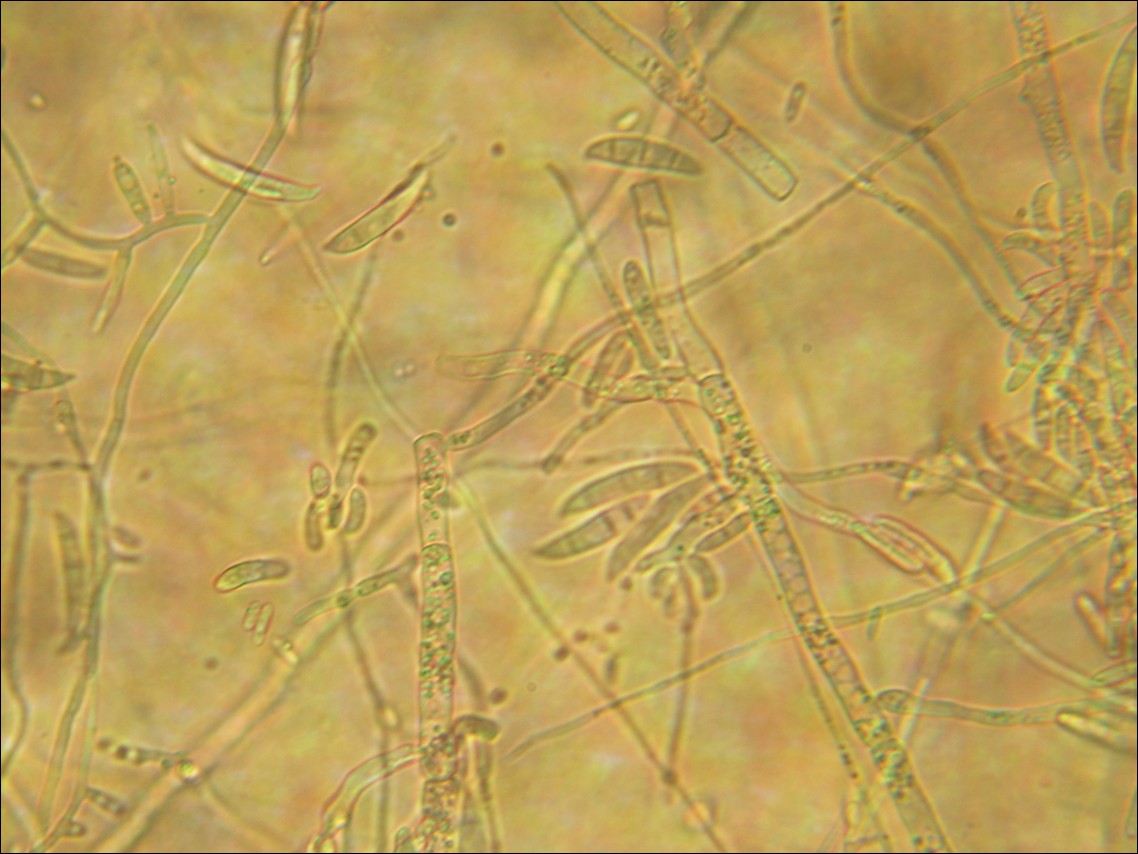
Fusarium is one of the economically most important pathogenic fungal genera in agriculture — root and crown rot, ear damage in cereals, mycotoxin formation. Against it, a natural antagonist has established itself on our fields all on its own.
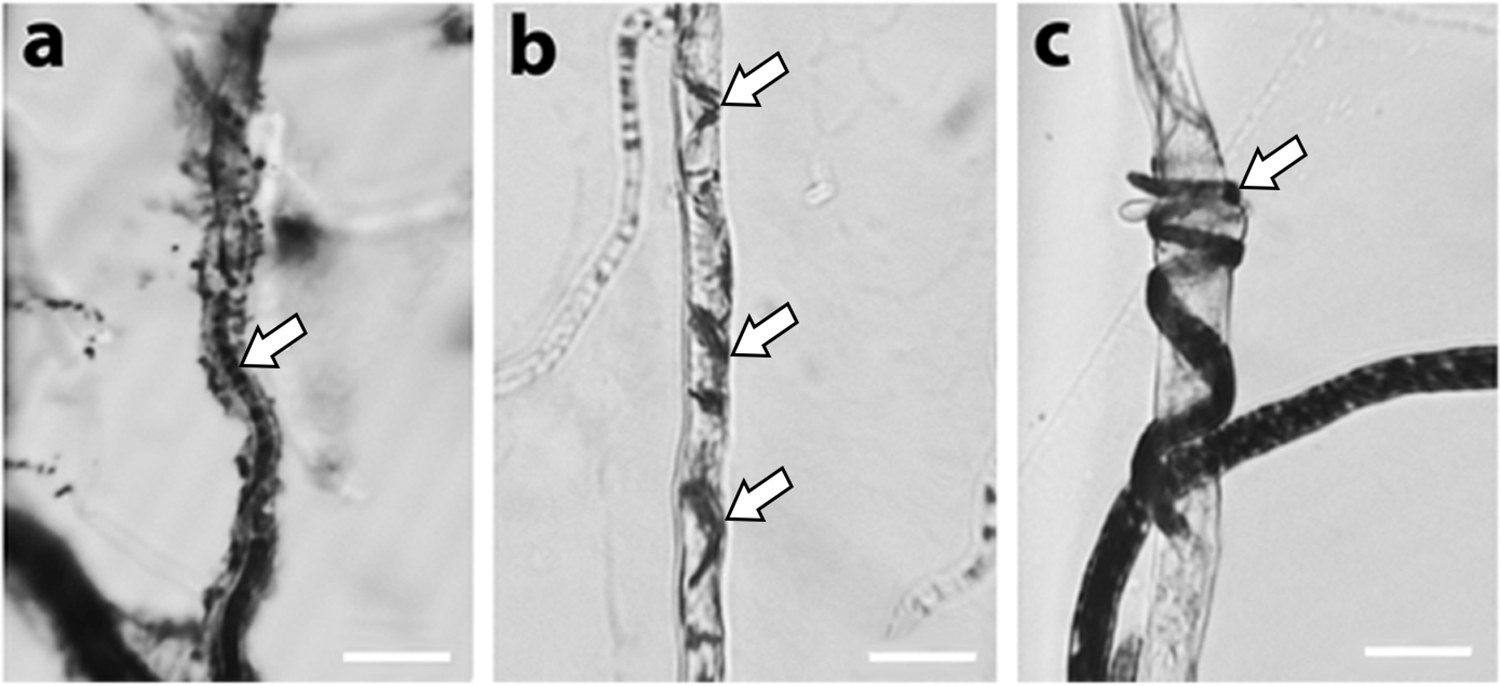
Clonostachys intermedia was found at three sites — ForsthausUnten, Spannweid Mix and Spannweid 14 — strongest in Spannweid Mix at 0.40% of fungal reads. The fungus works through several mechanisms at once: it physically parasitises Fusarium hyphae (mycoparasitism), competes for space and nutrients, produces antifungal compounds that block spore germination, and activates the plant's immune defence in the roots (priming).
To establish itself, Clonostachys needs abundant and diverse organic material, low soil disturbance and no fungicides; in conventionally tilled soils it typically disappears. It was never applied. Alongside it is Trichoderma reesei (Alter Obstgarten and Market Garden), another biocontrol fungus known for high cellulose-decomposition capacity and antagonistic action against other fungi and insect larvae — also not applied.
Clonostachys rosea (arrows) parasitising the hyphae of fungal pathogens; MTT-stained, scale bars 10 µm.
Fusarium conidiophores and sickle-shaped macroconidia (160×).
In our overview, Spannweid Mix is the only site rated complete on aggregation across all four levels. That fits the management: multi-year, low-disturbance, with an alternation between loam and peat zones within the same field — conditions under which a stable, multi-layered aggregate build-up can develop over years.
Spannweid Mix was also the only site where any arbuscular mycorrhizal species was detected at all (Claroideoglomus claroideum). Since this fungal group is only incompletely captured by the standard method, that is more of an incidental finding than a robust statement about symbiotic function1 — what stands out above all is the maturity of the aggregate structure.
Field: Haus Hügel
Diverse predators as a maturity indicator
At Haus Hügel, four predatory animals from different orders and on different levels of the soil food chain occurred together — a combination found at no other site:
Veigaia nemorensis, a predatory mite, eats nematodes and springtails (disturbance-sensitive, slow to reproduce). Histiostoma feroniarum, a mite, was found exclusively here — at 5.32% of all animal reads, the second-strongest single-species signal in the dataset. Clarkus papillatus is a predatory nematode that eats other nematodes, including plant-parasitic species. Poecilus cupreus, a ground beetle, eats aphids, slugs and other above-ground pests.
In soil ecosystems, predators are an indicator of relative maturity and low disturbance: they reproduce slowly, need enough prey across several trophic levels, and are the first to be lost under tillage or pesticide use. Their diversity here points to a comparatively well-developed soil system.
Field: Spannweid 14
Specialists at the nettle patch
In 2024, Spannweid 14 was a strip with a deliberately established nettle culture (Urtica dioica), planted in autumn 2022. Compared with the mixed sample from the same field, the soil is not richer but ecologically distinct.
The bacterial species count is similar (328 versus 323), yet 20 OTUs occurred only in Spannweid 14. The fungal community is clearly different, with more acid-loving Acidobacteria (41 OTUs, the highest number among the E sites) and the water-film cellulose decomposer Rhizophlyctis rosea. Nettle litter has a high nitrogen content; its root exudates select a specialised soil microfauna — less diversity, but more sharply defined specialisation.
What the DNA adds to the spade test
The spade test shows the observable result of soil biology — crumb structure, root penetration, compaction, earthworm channels. The DNA analysis adds what you cannot see: which organisms build aggregate stability (with names and function), whether biological disease defence is present (Clonostachys against Fusarium, Trichoderma against insect larvae), how diverse the predators are as a maturity indicator, and whether plant-parasitic nematodes appear as an early-warning signal. Together, the two methods deliver a more complete picture of whether a functioning soil ecosystem is actually forming on our fields.
To put the methodology in context: Lutz et al. (Nature Microbiology, 2023) analysed the soil microbiome of 54 Swiss maize fields. 13 key fungi explain 66% of the variation in plant growth between fields; the full microbiome model reaches 86% predictive accuracy — pathogenic fungi being the single strongest predictor, more important than the measured nitrogen content.
Limits of the method
DNA shows presence, not amount and not activity — a dormant and an active species look the same in the DNA. The 18S marker used does not resolve earthworm species; for detailed earthworm diagnostics, the spade remains the primary tool. There are so far few standardised reference values for Swiss arable soils, and with one sample per site (N=1) differences can be described but not statistically confirmed. The data is a solid starting point, not a final verdict.
Next steps
We have already taken new samples in 2026. As soon as we get the results back from NatureMetrics, we will add to this analysis.